A langoustine is not a prawn, and most menus do nothing to clear that up. It is a small clawed lobster, sold under at least four different names depending on which country you are standing in. This guide covers what the animal actually is, why scampi and langoustine mean the same thing, how we cook ours, and how many you need.
What a Langoustine Actually Is
A langoustine is a lobster. A small, slim, pale orange one with long thin claws, and the same body plan as the lobster you would recognise on sight, scaled down.
Its scientific name is Nephrops norvegicus, and it lives in burrows in muddy seabeds across the north-east Atlantic and parts of the Mediterranean. They reach a maximum of around 25 cm, though most arrive somewhere between 18 and 20 cm. That range explains why a langoustine comes to the table whole and why the eating is mostly in the tail.
The meat is sweeter and finer than prawn, closer to lobster than to anything else. That is the whole reason the animal is worth knowing about.
Langoustine vs Prawn vs Scampi
Three names, and only two of them describe different things. This is the part that confuses people, and it is worth spelling out plainly.
Langoustine and prawn are different animals. A langoustine is a clawed lobster; a prawn is not a lobster at all and has no claws worth the name. They look similar on a plate at a glance, which is where the mix-up starts, though the claws give it away immediately once you know to look.
Scampi is the same animal as a langoustine. The word is Italian in origin and usually refers to the peeled tails rather than the whole shellfish. So scampi and langoustine are the same creature described at different stages: one whole, one already shelled. Dublin Bay prawn and Norway lobster are two further names for the same thing.
None of that matters at the table, except that knowing it stops you ordering the same animal twice under two names.
How We Cook Them
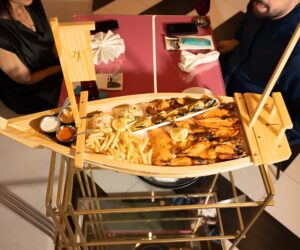
Langoustines get the same treatment as our prawns, which is deliberate. They are marinated, topped with our signature Pigalle basting, and grilled over open flame, then served with fries and rice.
Grilling suits them because the shell holds moisture while the outside takes on char, and langoustine meat is delicate enough that it would be lost under a heavy sauce. The basting sits on top rather than soaking in, so the sweetness of the meat still comes through. That balance is why we do not offer them any other way.
Three Sizes, and Who Each Suits
We serve langoustines in medium, large and extra large, and the difference is genuinely about scale rather than quality. Every size gets the same marinade and the same grill.
- Medium suits a first try, or a table ordering several things.
- Large is the middle of the range and where most tables land.
- Extra large suits an occasion, or someone who has had them before and wants the full version.
The practical guide is the same as for any shell-on shellfish. More work per piece, more reward per piece.
Langoustines in the Sharing Platters
Langoustines run through all three of our platters, which is the easiest way to try them without ordering a full portion. The Villamoura Platter pairs them with queen prawns and nothing else, so it is the cleanest direct comparison on the menu.
The Shellfish Platter adds baby lobster to the same idea, and the Seafood Platter for 2 widens it with mussels, calamari and line fish. If fish rather than shellfish is what the rest of your table wants, our page for the best fish restaurant in Dubai covers that side.
Why So Few Restaurants Here Serve Them
Langoustines are rare on Dubai menus, and the reason is structural rather than local. Almost every prawn you eat is farmed, while langoustines are wild-caught only, and those two supply lines have moved in completely different directions.
The FAO’s State of World Fisheries and Aquaculture 2026, published in June 2026, put farmed aquatic animal production above 100 million tonnes for the first time, at 103 million tonnes. Wild capture over the same period stayed flat, holding inside a range of 86 to 94 million tonnes since the late 1980s. That gap is the answer. Farming scales to meet demand and wild fishing cannot, so anything that only comes from the sea stays scarce while farmed shellfish gets more available every year.
Langoustines are also fragile. They deteriorate faster after landing than prawns or lobster, which is why so much of the catch becomes frozen scampi tails rather than whole shellfish. A kitchen serving them whole and grilling them to order has taken on a supply problem most restaurants sensibly avoid, and that is the honest reason three sizes of them on one menu is unusual here.
Who This Suits, and When to Order Prawns Instead
Langoustines suit people who already like shellfish and want something better rather than something bigger. They suit a slower meal, and they reward anyone willing to work at the shell.
Order prawns instead if you want more food for less effort, if you are eating quickly, or if the table includes anyone who would rather not dismantle their dinner. Prawns are the more forgiving order and there is no shame in it. Langoustines are the one to come back for once you know you like this kind of eating.
The Best Shellfish You Have Never Ordered
Langoustines sit in an odd gap. Better than a prawn, easier than a lobster, and hidden behind a name most people cannot place. Once you have had one properly grilled, the gap makes sense.
Book a table and try them beside the prawns to see the difference for yourself. Our team can suggest a size based on what else you are ordering. Start with the platter if you would rather not commit to a full portion.
FAQs
A langoustine is a small clawed lobster. A prawn is not a lobster and has no significant claws. Langoustine meat is sweeter and finer.
Yes, the same animal. Scampi normally refers to the peeled tails, while langoustine usually means the whole shellfish.
We grill them in three sizes at Villamoura, on Sheikh Zayed Road in Downtown Dubai. They also appear across all three of our sharing platters.
As a main course, one portion each. Inside a platter they are one element among several, so plan the platter around the table rather than the person.